
Fashion waste has become one of the most urgent environmental and social justice challenges facing Ghana. Every week, an estimated 15 million garments arrive in Accra’s secondhand markets from the Global North, with nearly 40% immediately discarded due to poor quality. These discarded clothes pile up in landfills, clog drains, litter beaches, and leach toxic microfibers into rivers and lagoons. The burning of excess clothing further releases harmful toxins into the atmosphere, increasing the risk of respiratory infections and contributing to climate change.
Anne Whiting’s Pulitzer-supported reporting (2023) brings global attention to this crisis. Her work documents how discarded garments overwhelm Accra’s coastlines and lagoons, disintegrating into microplastics that infiltrate food chains, ecosystems, and public health. This story frames the issue as waste colonialism, where wealthier nations export their fashion excesses to Ghana and other Global South countries under the guise of trade, leaving behind ecological devastation and economic burden.
Despite the growing awareness of plastic pollution in Ghana, the issue of fashion waste remains under-discussed in public and policy discourse. Communities directly affected, such as fisherfolk and coastal dwellers, witness firsthand the damage caused by mounds of discarded garments, yet their voices are often excluded from decision-making spaces. Youth, who represent the generation most affected by environmental degradation, also lack platforms to amplify their ideas and contribute meaningfully to sustainable solutions. Without targeted awareness, creative advocacy, and policy engagement, Ghana risks continued entrenchment in a cycle of dependency and pollution driven by fast fashion and secondhand clothing imports.
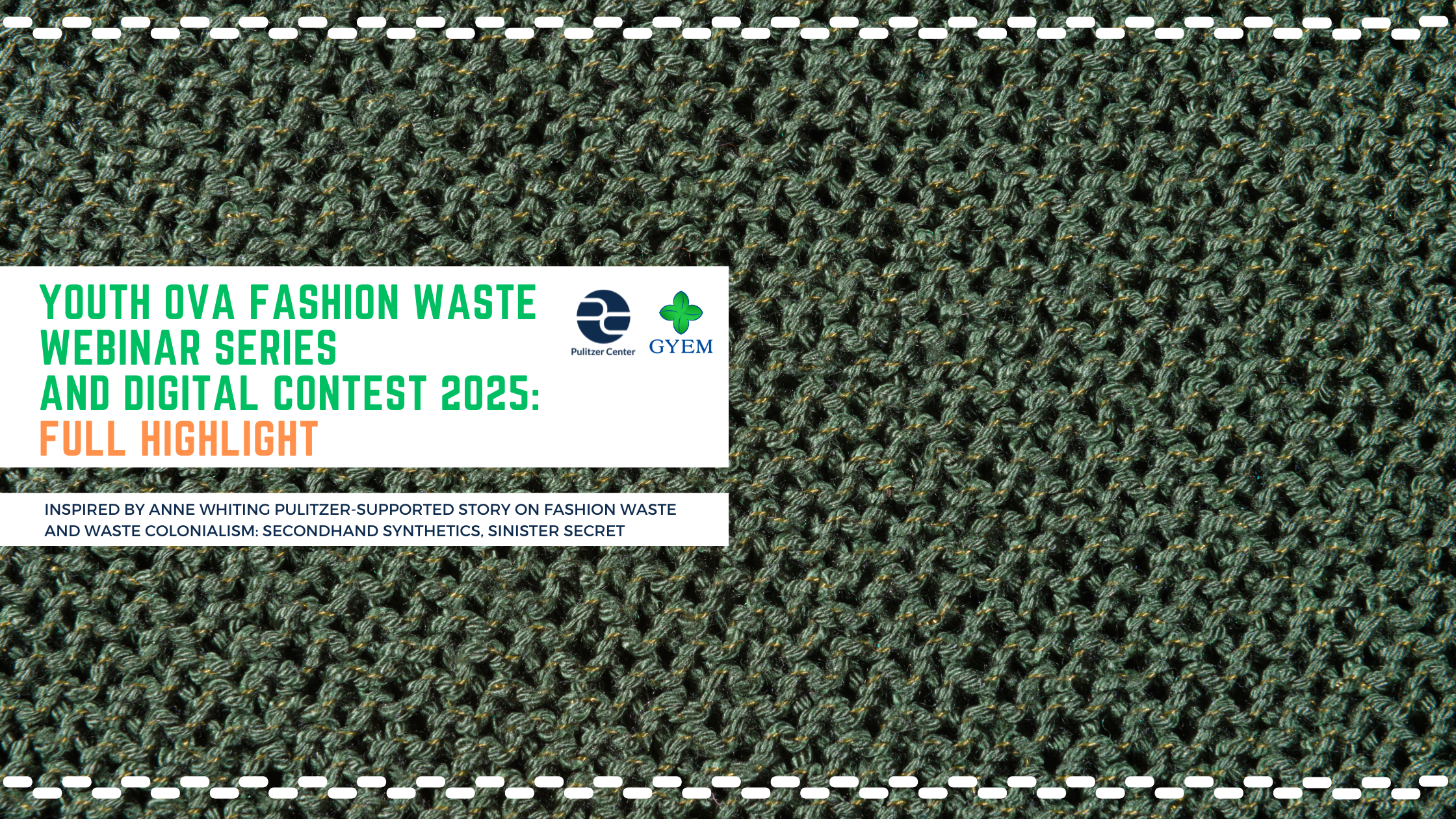
Against this backdrop, the Ghana Youth Environmental Movement (GYEM) with support from the Pulitzer Center, launched the YouthOvaFashionWaste Webinar and Digital Contest on the 13th of October 2025, under GYEM’s Sustainable Fashion Campaign and the Pulitzer Center’s Africa Outreach Initiative.
Inspired by Anne Whiting Pulitzer-supported story on fashion waste and waste colonialism: Secondhand Synthetics, Sinister Secret, the YouthOvaFashionWaste Campaign created a digital platform where youth voices unravled the truth about fast fashion and its ecological impacts. The Campaign featured a three series webinar, and a youth digital storytelling contest that brought together youths, sustainable fashion innovators, creatives, scientists & researchers, policymakers, and journalists across Ghana to rethink how our fashion habits and global trade systems affect people, the planet, and our shared future.
Webinar 1 – Youth Perspectives on Fashion Waste & Waste Colonialism
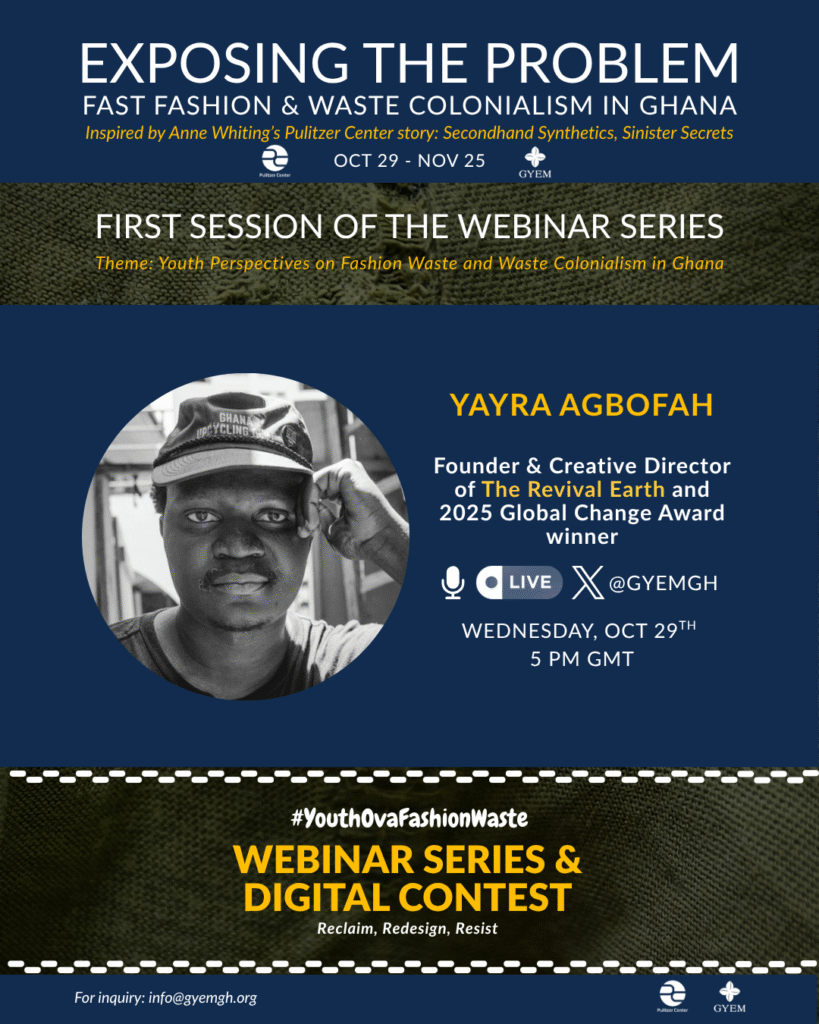
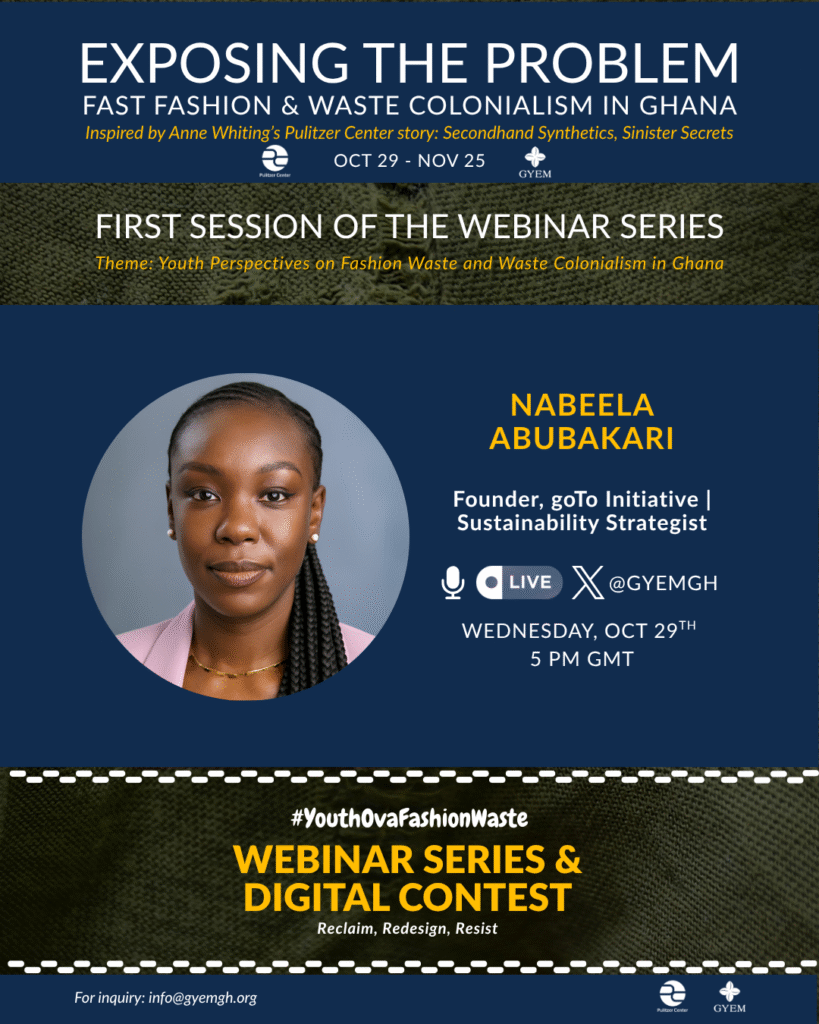
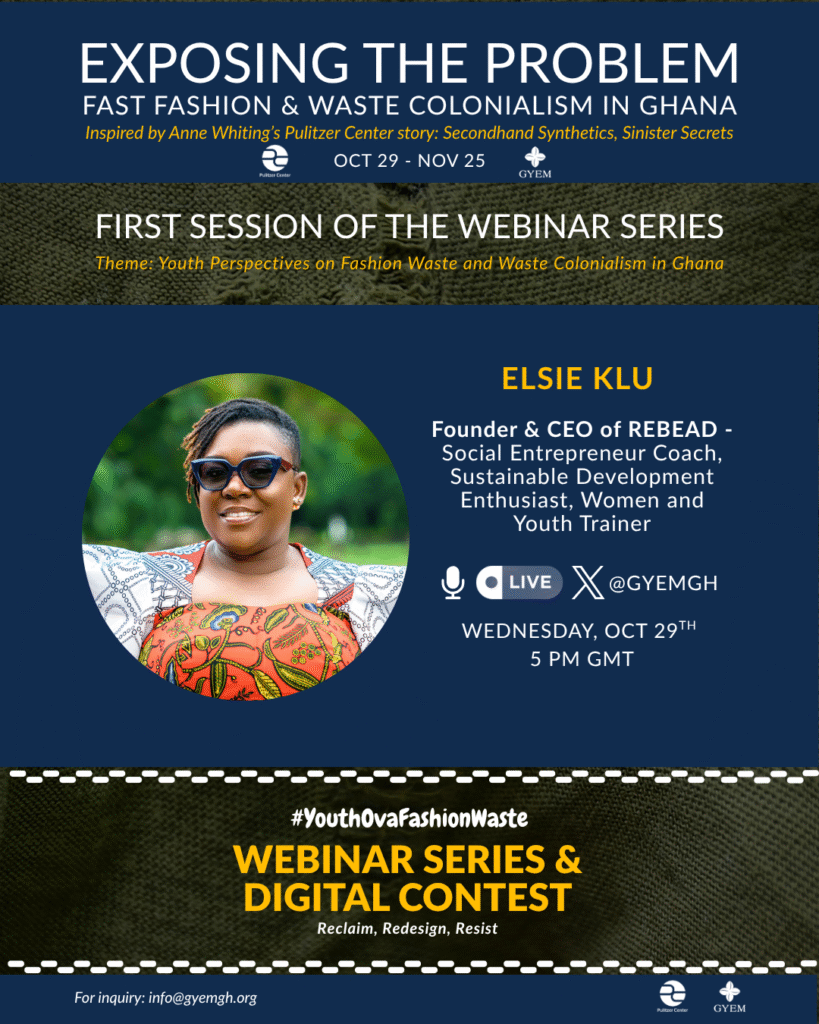
The first session brought together young innovators who have seen the crisis up close and are actively building solutions. Our speakers included Nabeela Abubakari, a Sustainability Specialist from the goTo Initiative; Yayra Agbofah, the Creative Director and 2025 Global Change Award Winner from Revival Earth; and Elsie Klu, Women and Youth Trainer and Social Entrepreneur Coach from Rebead World.
Key Highlight:
Nabeela Abubakari emphasised the need for a mindset change in how Africa approaches fashion sustainability. She stated, “We need a narrative shift that develops African sustainable fashion as a global standard.” Her message encouraged participants to move beyond dependence on Western systems and instead invest in homegrown innovation.
Yayra Agbofa, focused on local responsibility and empowerment. he remarked, “We have the power to say no to unsellable secondhand clothing and create better systems for traders and our environment.” Yayra’s insight highlighted the need for stronger community awareness and policy support to reduce the influx of poor-quality clothing and to promote sustainable livelihoods for traders.
Elsie Klu stressed the importance of collaboration across the entire fashion value chain. She noted, “Collaborative action across the supply chain is critical to addressing fashion waste.” Her contribution underscored that progress requires cooperation among designers, producers, policymakers, and recyclers to build a truly circular system.
Among numerous key takeaways, we all agreed on the necessity of a collaborative effort among multiple stakeholders in the supply chain to address the excess textiles that contribute to fashion waste. Listen to the full recording here.
Webinar 2 – Policy Frameworks and Governance
Next, we shifted from problems to systems, who is responsible, what policies exist, and how youth can influence them.
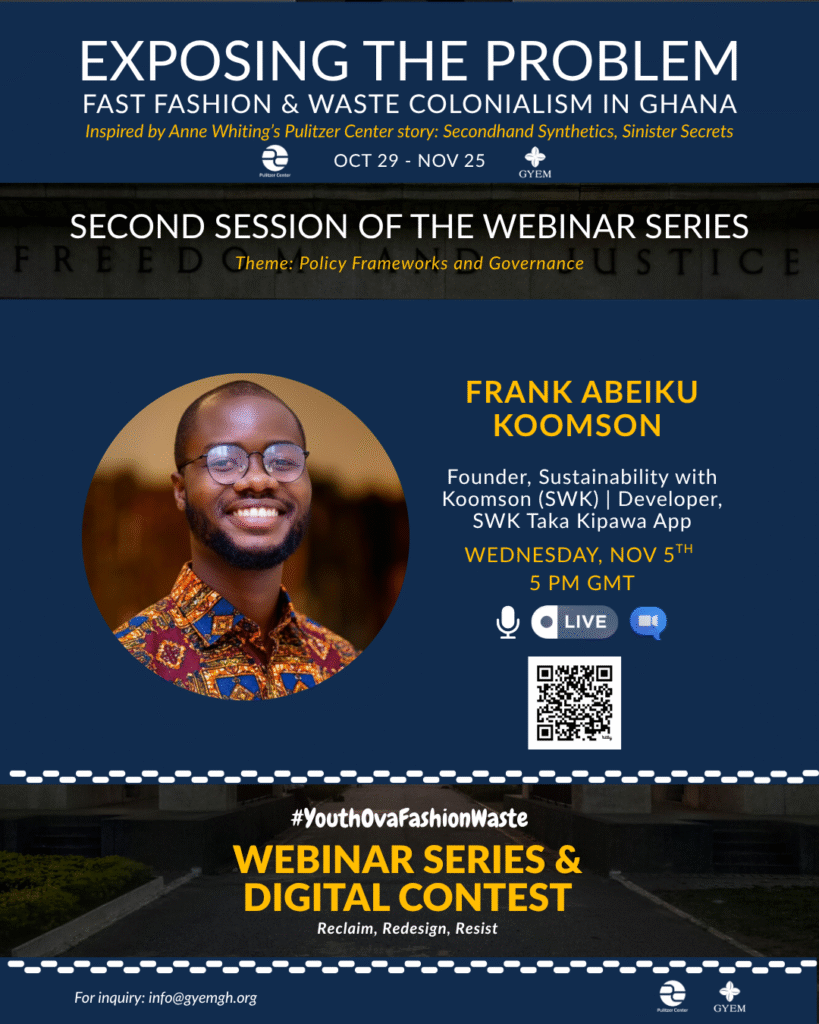
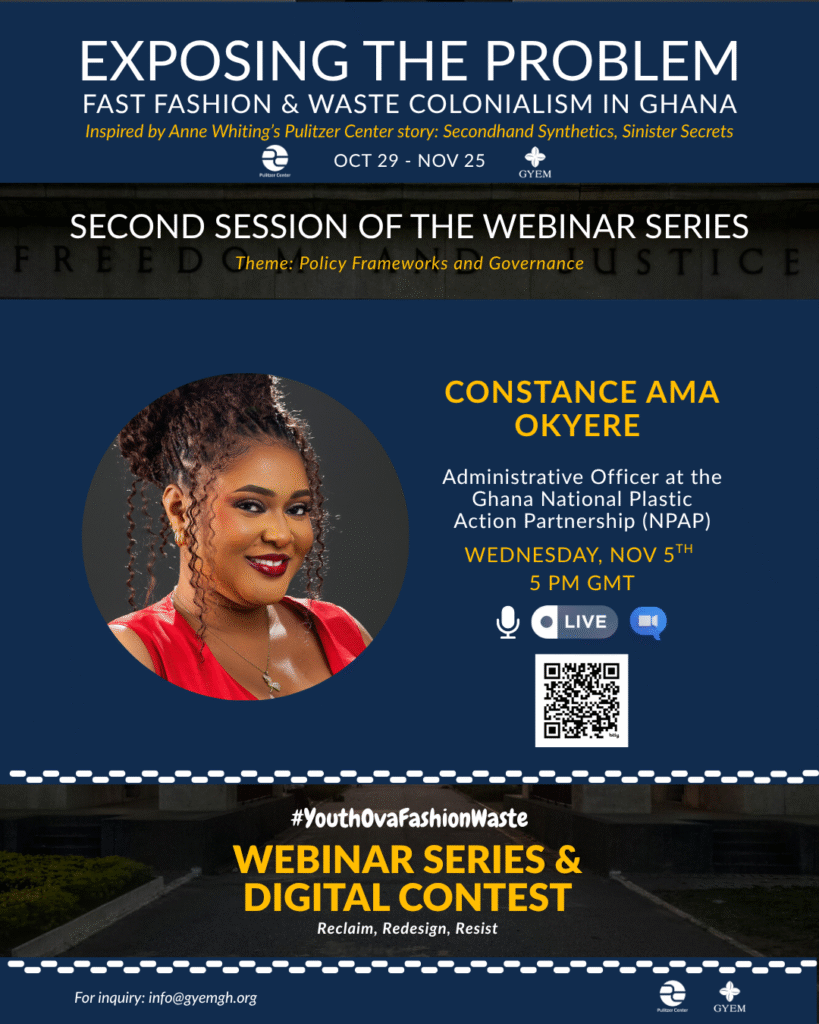
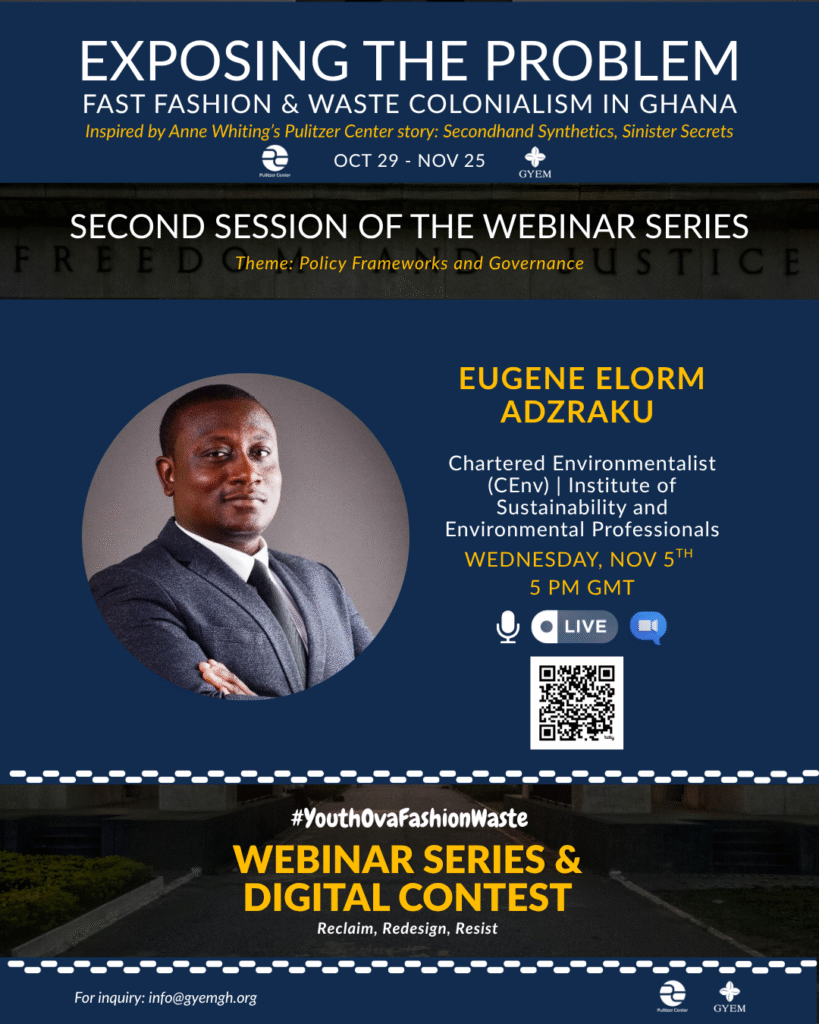
Experts including Frank Koomson, Constance Okyere (NPAP), and Eugene Adzraku (EPR Technical Working Group) broke down the policy landscape.
Key Highlight:
The session established a strong connection between textile waste and national plastic management policies, identifying opportunities for EPR integration and youth involvement in governance.
Mr. Frank (Abeiku) Koomson showcased youth-led innovations such as the Taka Kipawa App, a digital platform that upcycles waste materials into valuable products. His presentation demonstrated how technology and creativity can drive sustainable solutions while empowering young people to turn waste into economic opportunities.
Ms. Constance Okyere highlighted the connection between synthetic textiles, microplastic pollution, and Ghana’s waste governance frameworks. She emphasised the need for stronger policies to manage textile waste within the broader national plastics agenda, ensuring that sustainability remains at the core of production and consumption.
Mr. Eugene (Elorm) Adzraku discussed Ghana’s Extended Producer Responsibility (EPR) scheme and its relevance to the secondhand clothing industry. He explained how EPR can hold producers accountable for the life cycle of their products, promoting shared responsibility and improved waste management practices across the fashion sector.
The second webinar deepened understanding of how effective governance and policy frameworks can shape sustainable solutions to fashion waste in Ghana. It reinforced the importance of aligning innovation, regulation, and accountability to create a circular and responsible fashion economy.
Additionally, Larry Kotoe, a member of the Environmental Protection Authority (EPA) discussed the agency’s initiatives for addressing textile and plastic waste, while Nunana Agbemabiase, a representative from the Ministry of Environment, Science, and Technology (MESTI) encouraged the adoption of eco-designs, urging producers to reduce the number of plastics in their products.
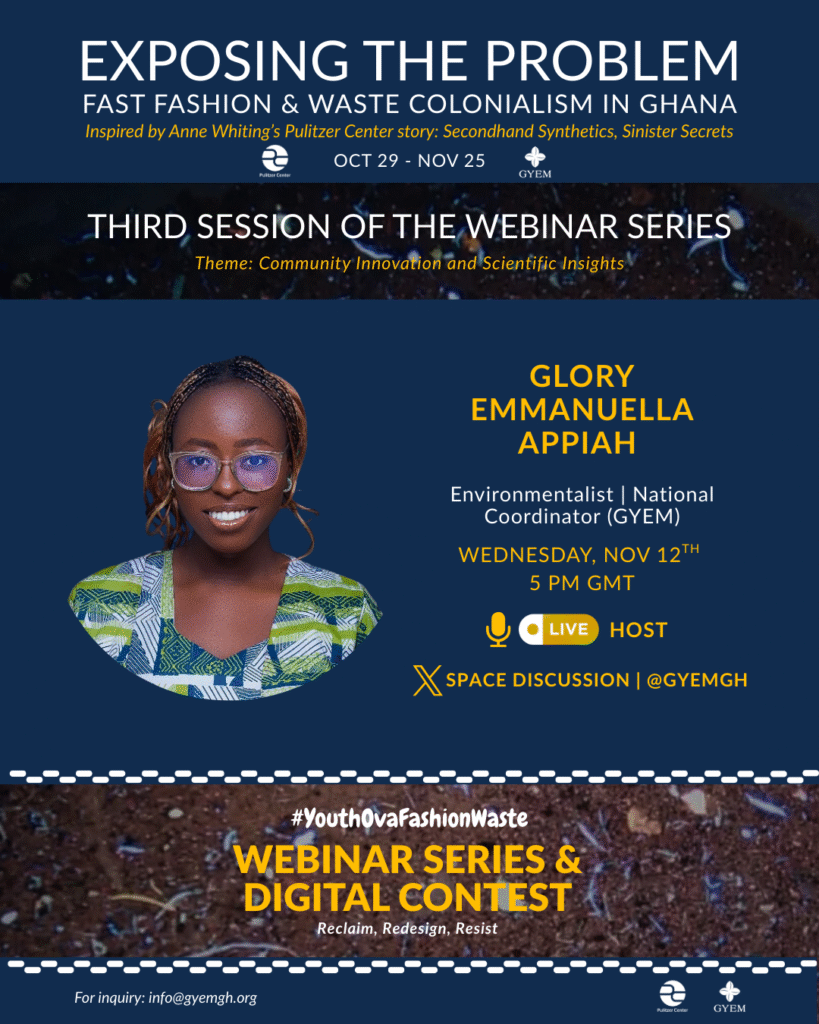
Webinar 3: Community Innovations and Scientific Insights on Fashion Waste
The final session zoomed in on what discarded clothes do to our water, our oceans, and our bodies.
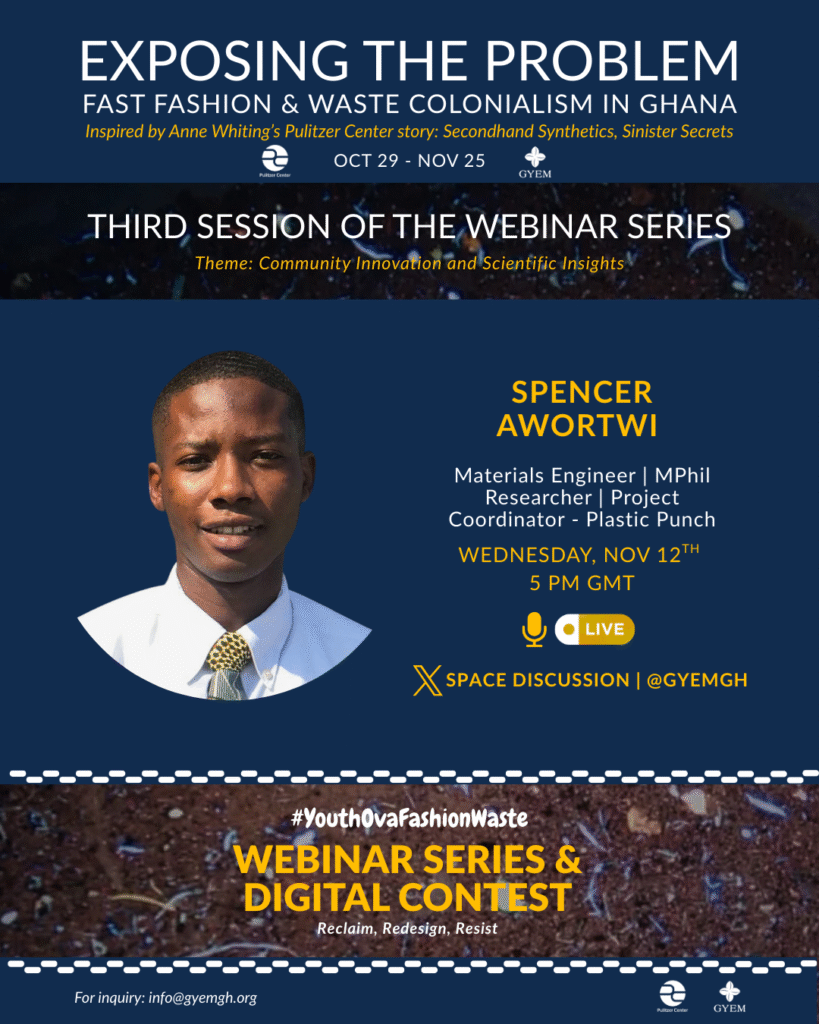
Key Highlights:
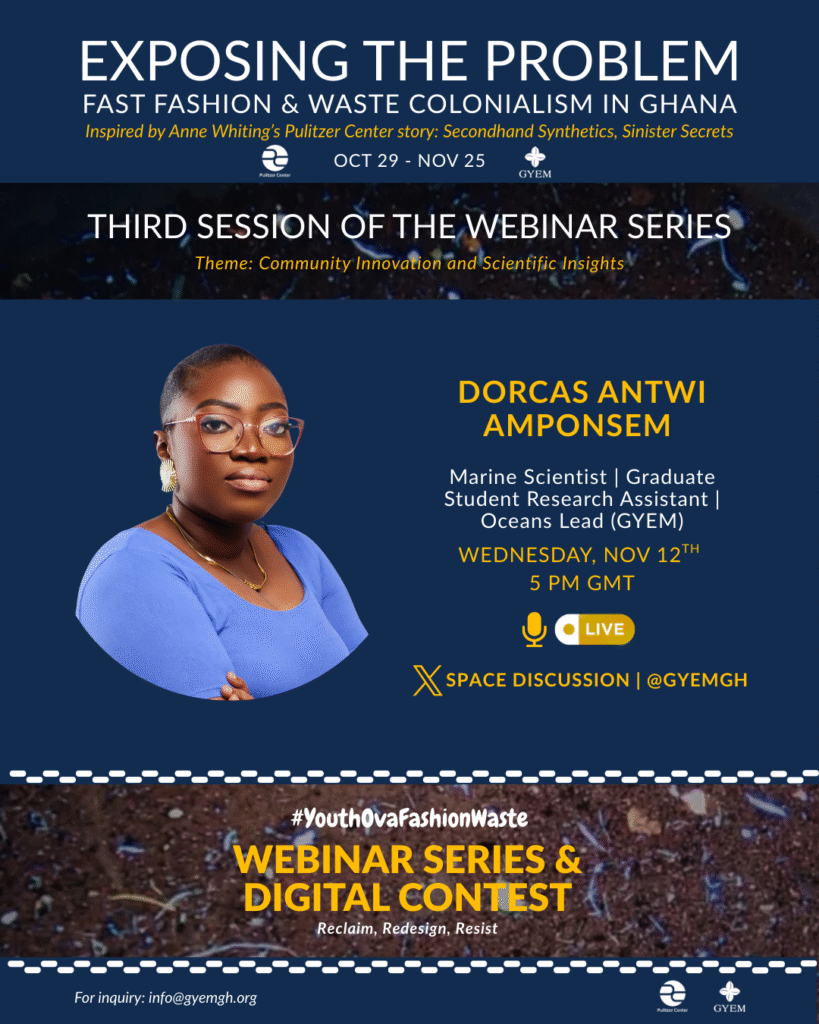
Dorcas Antwi, Marine Scientist and Oceans Lead at GYEM, shared scientific insights into how textile waste contributes to marine pollution. She explained that fabrics such as polyester and nylon break down into microfibers that flow through drainage systems into Accra’s lagoons. Because waste treatment plants cannot filter these fibers, they eventually enter the ocean, threatening aquatic life and human health. She noted that the Kole Lagoon has one of the highest reported microplastic concentrations in West Africa, with 1,400 to 6,000 particles per cubic meter found in its sediments.
Spencer Awortwi, a Materials Engineer and Project Coordinator at Plastic Punch, highlighted community-driven innovations aimed at addressing this crisis. He shared that Plastic Punch regularly organizes beach clean-up exercises to raise awareness and inspire behavioural change. Through these efforts, they also train residents to become citizen scientists, equipping them with the knowledge and skills to collect data and contribute to evidence-based environmental action.
The Digital Contest: Creativity Meets Climate Action
After weeks of learning, youth across Ghana transformed their knowledge into storytelling and advocacy.
The YouthOvaFashionWaste Digital Contest received powerful article entries highlighting:
- The human cost of fashion waste
- Creative solutions to reduce, reuse, and redesign
- Calls to action for policy and behavior change
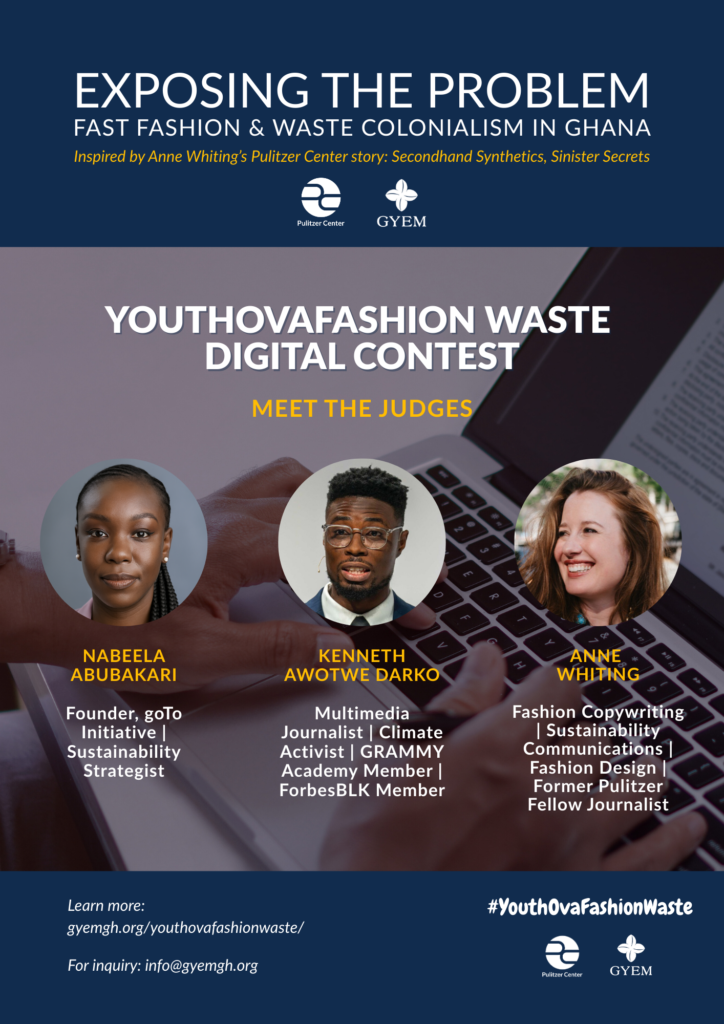
A three-member judging panel evaluated entries based on impact, creativity, and clarity. This process helped amplify youth voices in national and global conversations in Ghana’s circular fashion. The following three articles stood out amongst the entries and each writers won cash prizes, mentorship opportunities, and had their articles published on GYEM’s website and on one of Ghana’s most prominent media platforms, Myjoyonline.com.
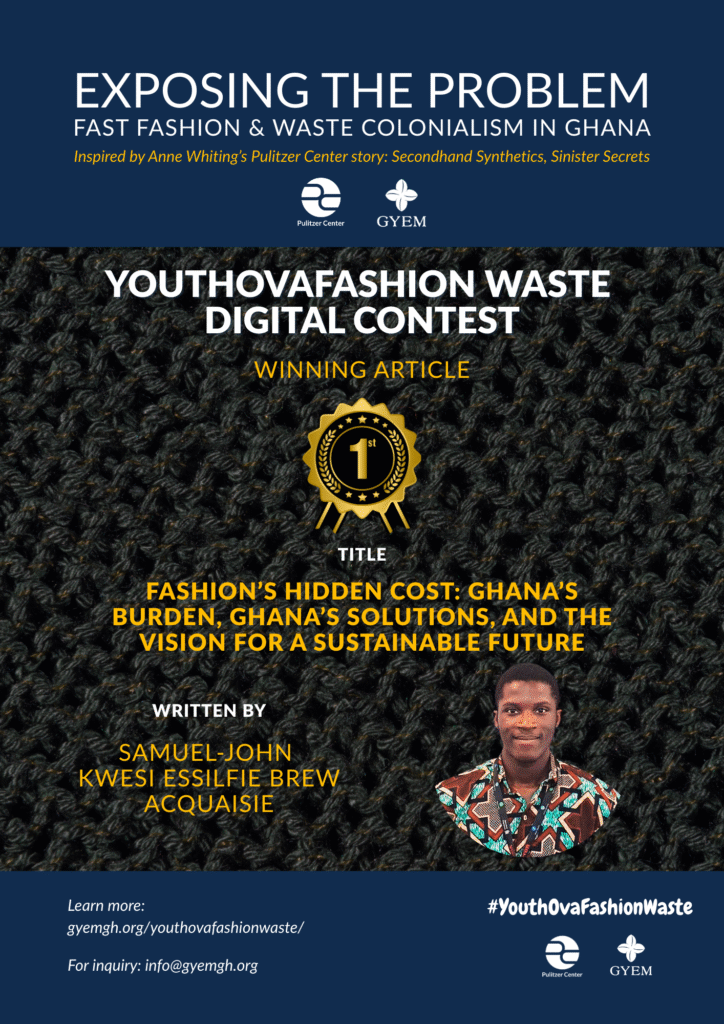
Written by Samuel-John Brew Acquaisie
Samuel-John Brew Acquaisie is a final-year Bachelor of Science in Administration student at the University of Ghana, majoring in Accounting, with a growing interest in sustainability and environmental advocacy.
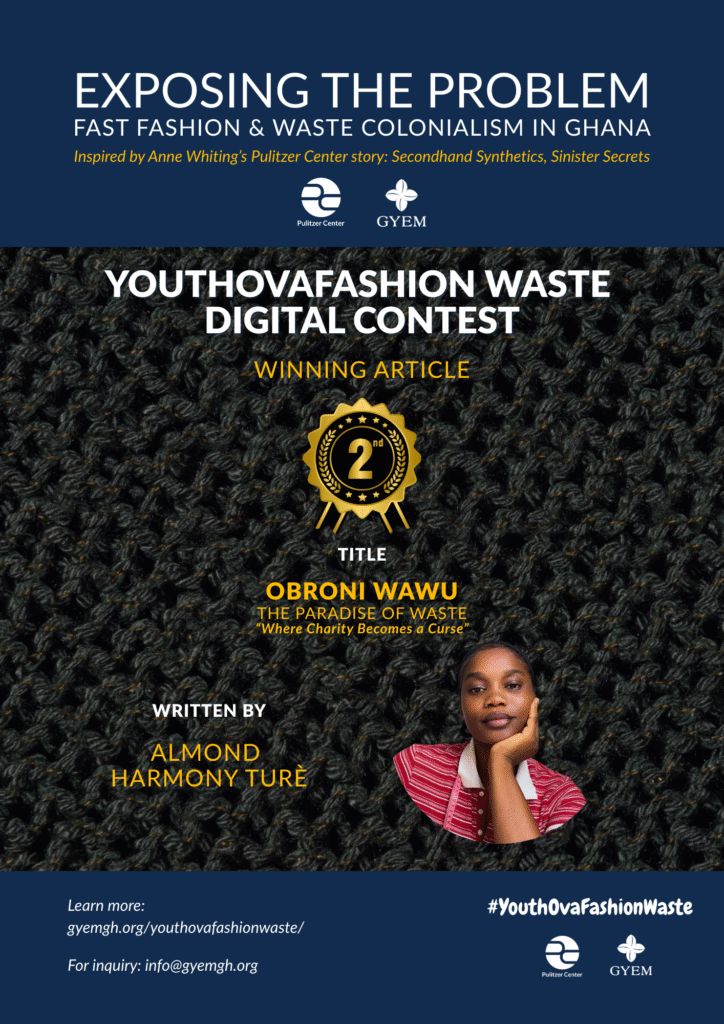
Written by Almond Harmony Ture
Harmony is a visionary fashion designer and cultural advocate whose work bridges artistry and purpose. Through her designs and writing, she seeks to elevate Africa’s fashion narrative, championing sustainable practices and homegrown innovation. Committed to redefining global perceptions, she creates with intention celebrating heritage, creativity, and the transformative power of design.
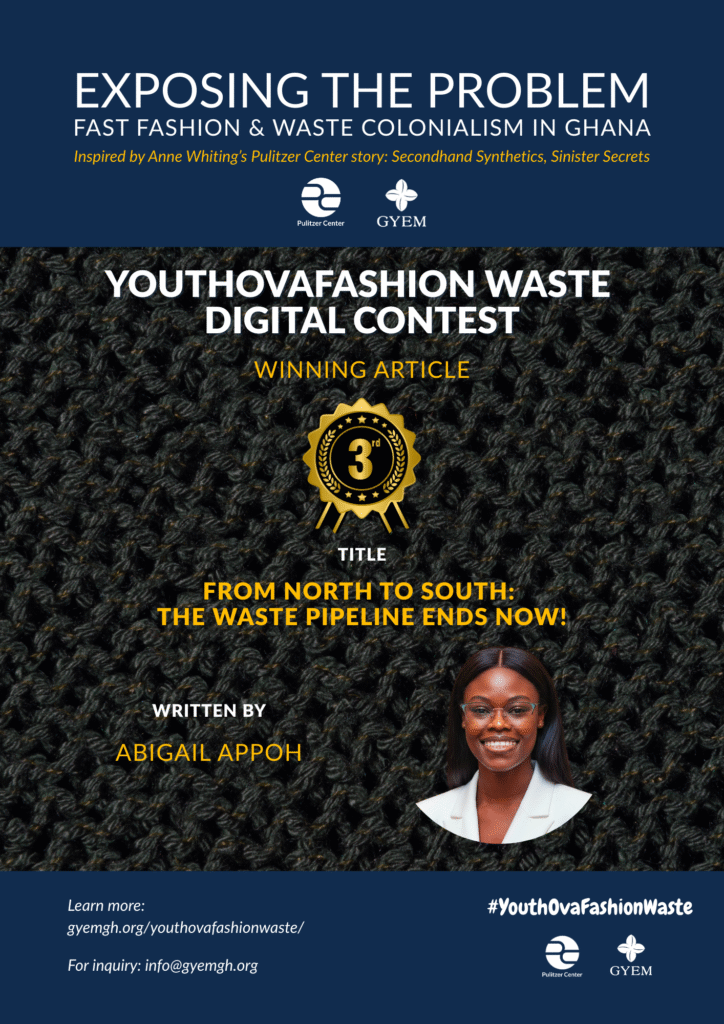
Written by Abigail Appoh
Abigail Appoh is a final-year student at the University of Media, Arts and Communication – Institute of Journalism (UniMAC–IJ), where she explores the power of storytelling to spark environmental awareness. As an advocate for sustainability and digital empowerment, she blends creativity with purpose to spotlight real issues in her community. Abigail is passionate about shaping narratives that inspire young people to find their voice and make meaningful change.
Overall Achievements and Outcomes:
- Awareness Raised: Over 5,000 people reached through webinars, livestreams, and social media posts
- Youth Empowerment: Built capacity among young people to critically analyse fashion waste and advocate for systemic change.
- Knowledge Exchange: Connected stakeholders from science, policy, and social enterprise to foster collaborative solutions.
- Policy Influence: Elevated discussion on the role of EPR and national plastic frameworks in addressing textile waste.
- Amplified Journalism: Translated Pulitzer-supported reporting into tangible youth-led advocacy and civic engagement.
Next Steps and Call to Action:
- Continue advocacy efforts through GYEM’s Sustainable Fashion Advocacy Unit.
- Seek partnerships to sustain these webinar series.
Join the Movement
Follow GYEM’s social media platforms for updates, resources, and the upcoming publication. YouthOvaFashionWaste isn’t just a campaign.
It’s a generation refusing to stay silent.
Together, we can:
Reclaim our narrative
Redesign our systems
Resist waste colonialism